Reviewed this week
click image to go directly to manufacturer site
SCIENTIFIC ANGLERS Amplitude Smooth Trout GP fly line
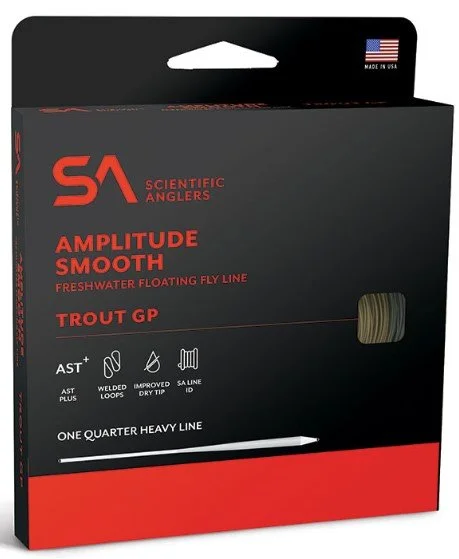
If you stalk trout rather than just fish them, this is a line you’ll want to know about. Scientific Anglers paired a specialized compound taper with some advanced chemistry, and the result is a floating line that shows what a general-purpose freshwater taper can do on a modern medium/fast rod.
Don’t let the “GP” designation fool you. It stands for General Purpose, but there’s nothing entry-level about the line. SA borrowed the mass-forward belly from their Infinity taper, then stretched out the front and rear tapers considerably. The head ends up mid-length, around 49.5 feet in a 4-weight and up to 53 feet in an 8-weight, and it still manages to load like a distance line while landing as softly as a presentation line. That’s a clever bit of engineering, and it’s the reason the line feels like two tools in one.
Also (and I found this quite crafty), it’s built a quarter-line size heavy. A 5-weight carries 145 grains in the first 30 feet instead of the AFFTA standard 140. That bit of extra heft gets fast graphite rods bending almost instantly at short range, yet it will not swamp a glass or medium-action rod on the presentation cast (we tested the line on three different category rods). The long head makes mending and line control a pleasure, even when you’re wrestling a tricky multi-current drift and the water is trying its best to drag your fly sideways.
Also setting the Amplitude Smooth apart is AST Plus. Instead of a surface dressing that wears off or collects grime, the slickness agent is spread throughout the braided core and PVC coating. As you fish and wipe the line clean, fresh lubricant keeps migrating to the surface, so the line never gets that tired, sticky feel by mid-season. SA claims five times less guide drag and up to eight times the durability of traditional lines. I’ll admit that five-times figure raised my eyebrows, but the line does shoot like it’s greased, and it holds its speed even when you’re punching into a stiff headwind. The hydrophobic finish also keeps the Improved Dry Tip riding high in the film – there’s no creeping tip-sink that plagues lesser lines after a few hours.
On the water
Next to SA’s more aggressive MPX or Infinity lines, this one leans toward finesse. It will put a size 20 adams down with barely a ripple, the sort of presentation that doesn’t spook a fish sitting in eight inches of flat, clear water. Thanks to the quarter-weight bump and that mid-length belly, it doesn’t fall apart when you switch to a tandem (but small) nymph rig, a bulky indicator, or a small woolly bugger. Those are the casts that usually expose a delicate line, and here they just feel like a slightly heavier version of the same easy stroke.
I also like the Butter/Sage/Willow color scheme. The muted willow tip stays inconspicuous in the fish’s window, and the high-contrast transitions make it easy to judge distance and time your pickups, which matters more than people admit when the light goes flat.
If you want a smooth, quiet line without the guide hiss of a textured one, the Amplitude Smooth Trout GP is a joy to fish. It has excellent casting feedback, stable loops, and (according to S/A) impressive durability,
★★★★★
Salter
by Thomas R. Pero
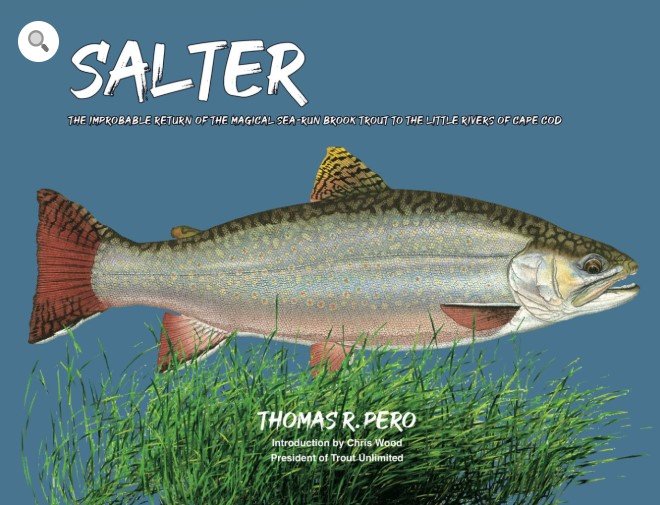
Every so often a book comes along that rescues a piece of vanishing folklore before it disappears entirely. Salter, Thomas R. Pero's handsome new natural history from Wild River Press, is exactly that kind of rescue mission. Its subject is the sea-run brook trout — an old Cape Cod term for a fish, more properly Salvelinus fontinalis, that migrates between fresh and salt water and once thrived in coastal rivers from the mouth of the Hudson north into Canada. Pero calls it an ecological "hood ornament," a small, jewel-colored creature whose fate says a great deal about the health of the little rivers it depends on. Few readers outside a small circle of anglers and biologists have ever heard the word "salter," and that is precisely the gap this book sets out to fill.
Pero, a veteran outdoor writer and publisher with a long history of first-rate fishing books to his name, structures Salter less like a field guide than like an investigative narrative. He traces the fish's decline from its nineteenth-century heyday — when literary and political figures fished Cape Cod's streams for salters — through a long twentieth-century collapse driven by dams, pollution, and (incredibly) cranberry agriculture, and into a genuinely uplifting present-day recovery. The most memorable stretch of the book follows the 1976 removal of an obsolete dam on the Quashnet River, an act of grassroots defiance carried out by volunteers inspired, fittingly, by Edward Abbey's The Monkey Wrench Gang. From there, Pero builds outward into the larger, decades-long story of dam removal and river restoration now underway across New England, anchored by interviews with two state fisheries biologists who have spent half a century studying these streams.
What elevates the book above a straightforward conservation success story is Pero's refusal to tidy up the ending. He gives real space to the threats still facing Cape Cod's rivers, particularly nitrogen loading from residential septic systems, which seeps through the Cape's porous soil into shallow estuaries and starves eelgrass meadows of oxygen. It's a sobering counterweight to the book's more triumphant chapters, and it keeps Salter from tipping into nostalgia or easy environmental optimism. The restored rivers are real, Pero insists, but so is the ongoing threat to them — and the two facts have to be viewed and held together.
Visually, this is a lavish production: 257 pages on heavy matte stock, printed entirely in color, with historical maps and photographs sitting alongside striking contemporary images of the trout in their native streams. It's the kind of book meant to be handled as much as read (I flipped through the entire book, twice, to inspect the visuals - before I started reading it), and the standard hardcover, along with a signed, leather-bound limited edition, reflects that ambition. At its core, this book constitutes a regional natural history, but the production values are genuinely part of the book's value — this is a species and a landscape worth this level of care.
Pero's prose has the unhurried, close-observational quality you'd expect from a lifelong angler rather than an academic naturalist, and the book is at its best when it stays with individual rivers and the people who fought – and continue to fight - for them, rather than zooming out into policy. Readers looking for a rigorous scientific monograph on brook trout genetics or migration may want a supplementary source. But as a portrait of a nearly forgotten fish and the unlikely coalition of biologists, veterans, and volunteers working to bring it back, Salter succeeds handsomely. It's a hopeful book that never loses sight of how fragile that hope still is — and a fitting tribute to a fish whose name that, until now, many of us may not have heard.
★★★★★
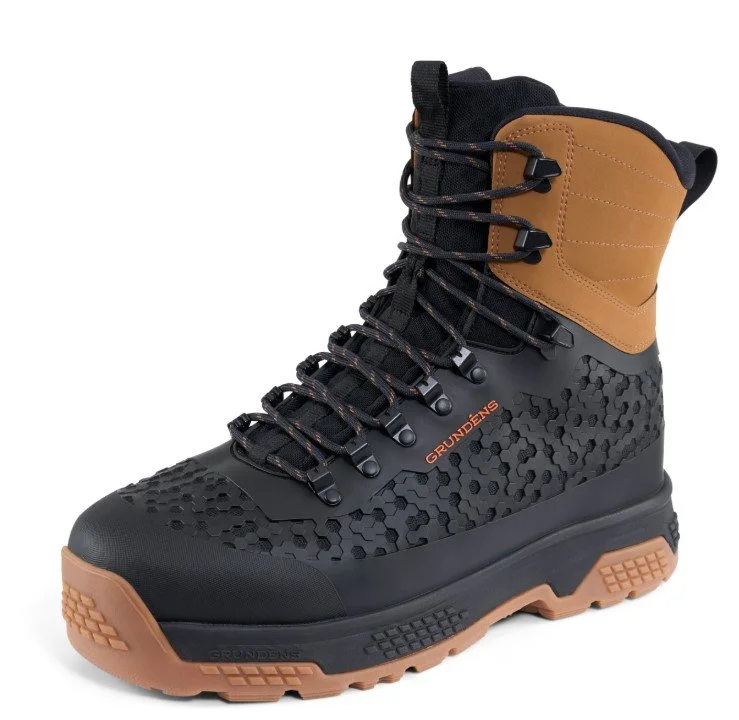
GRUNDENS
Rock Armor
wading boot
Wading boots are the gear I resent paying for most. They get dragged over gravel, jammed between boulders, and soaked every trip, and they usually die the same way: a seam lets go or the upper shreds.
When Grundéns released a boot built around fixing that, I paid attention.
Fit and comfort first
Right out of the box, the boot feels less like a technical wading boot and more like a well-broken-in hiking boot. Gotta love that.
After a full season of wading everything from stony mountain streams to silty tailwater, the Grundéns Rock Armor boot has earned a permanent spot in my car. I had big expectations, the boots delivered.
The idea is simple. The shell is a single sheet of perforated thermoplastic rubber bonded to a mesh backing, which means very little stitching to fail. I think that's the right problem to attack. The hex pattern of holes sheds water and helps the boot flex. A rubber wrap also covers the high-wear zones along the sides. It reads as protective without looking like a brick.
Getting them on is the other selling point. The gusset system is meant to make slipping in and out over neoprene booties easy. One reviewer went further, calling them the easiest boots to put on and take off he's fished. Anyone who has fought a stiff boot over wet neoprene at dawn knows why that matters.
Traction is where I pay closest attention. The outsole is gum rubber. That's fine for most riverbeds and kinder to the boot over time, and felt is banned in several states anyway. But rubber is less sticky on slimy rock. GearJunkie's tester wished a felt-sole version existed. If you fish algae-covered boulders, plan on adding studs.
One concern: Silt. I'd expect a perforated shell to let some grit in. Be sure to check after a muddy day.
Who it's for: Anglers who wade rocky rivers and bushwhack to get there, and who've lost boots to torn uppers. The shell design directly addresses that failure, and the easy entry is a real daily convenience.
Bottom line: It's the most sensible attempt I've seen at a longer-lasting wading boot. Way to go, Grundens.
★★★★